
At Golf Car UK, we know that golf clubs rely on their buggies every day to deliver seamless service to members, visitors, and society groups. Two critical factors that determine how effectively a fleet performs are charging speed and usable battery capacity. Understanding the differences, and the limitations of battery types, can help clubs get more out of their fleet while reducing downtime and operational headaches.
The difference between charging speed and usable capacity.
It’s easy to confuse these two concepts, but they’re distinct:
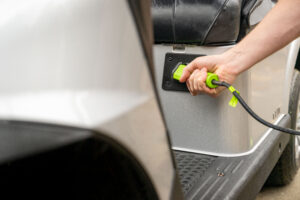
- Charging speed refers to how quickly a battery can be recharged after use. Faster charging means less downtime and more flexible scheduling.
- Usable capacity is the portion of the battery’s total energy that can safely be used without damaging the battery. A battery may have a high total capacity, but if only a portion can be safely drawn, the effective energy available for a buggy is lower.
In short: fast charging gets your buggies back in play quickly, while higher usable capacity lets them run longer between charges.
Why some batteries can’t safely discharge fully.
Different battery chemistries handle discharge differently:
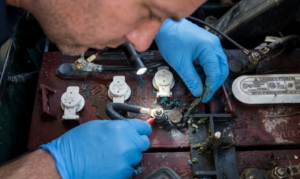
- Lead-acid batteries are sensitive to deep discharge. Drawing too much power reduces lifespan, leading to more frequent replacements. Clubs often operate these batteries conservatively, using only a fraction of their total capacity.
- Lithium batteries, on the other hand, tolerate deeper discharges without damaging the cells. This allows clubs to take advantage of more of the battery’s energy for longer runs.
The result is that lithium-equipped buggies can often operate longer between charges, while lead-acid vehicles require more frequent, partial usage.
How partial charging and downtime creep into daily operations.
When batteries can’t be fully discharged safely, and charging is slow, clubs face practical challenges:
- Buggies must be rotated frequently to avoid running one battery down too far
- Partial charges may be applied “just in case,” resulting in wasted energy and longer overall charging time
- Staff spend extra time checking battery status, moving vehicles, and managing charging schedules
These small inefficiencies add up, leading to less time on the course, more downtime, and higher operational stress, especially during peak times.
The freedom of faster charging and deeper usable capacity.
Batteries that support faster charging and a higher usable capacity — such as modern lithium options — unlock a new level of operational freedom:
- Buggies are ready to go sooner, reducing downtime between rounds
- Fewer rotations are needed, simplifying fleet management
- Longer runs are possible, maximising usage during peak times
- Reduced total battery wear and longer lifespan, lowering long-term costs
For golf clubs, this isn’t just a technical improvement, it’s more efficient operations, happier members, and a more profitable fleet.
Maximising fleet performance.
By understanding the differences between charging speed and usable capacity, and by choosing the right battery technology, clubs can optimise their buggy fleets to:
- Deliver more reliable service
- Reduce time spent on charging and maintenance
- Protect equipment investment
- Improve the overall experience for golfers
We help clubs navigate these choices, ensuring that every buggy in your fleet is performing at its best, whether you’re upgrading batteries, managing mixed fleets, or planning for future growth.